

how i wrote 8,000 words in a week
the flood after the drought.

By nature, I am a slow, plodding writer. I write in short, desperate gasps, sprinting with friends and sighing in relief when I’m done pounding out an especially strong excerpt. So when my tendency to procrastinate—a tendency I am actively working on improving—leads me to speeding to complete projects, I have to put a process in place in order to make sure that the work gets done on time.
This spring was one such time. Producing words was hard for me; a lot of that was due to physical exhaustion from working my first (and hopefully last) retail position. I wasn’t used to being on my feet for four or five hours at a time while managing the emotions of both myself and any customers who came in. These quiet negotiations sapped my energy. For $13/hour, it just wasn’t worth it.

I feel like I lost a month because of that bookstore job. I worked, came home, slept, ate, slept again, woke up, worked. I remember little to nothing that happened other than a quick yet meaningful trip to Chicago (if you can call a trip to busy Chicago, of all places, a period of rest). I remember so much sleep and our monthly pick books and my ecstasy at placing books in the little employee holds corner behind the register so I could buy them come payday.
What I don’t remember is writing.
Normally, a break from writing is fine for me; in fact, I’m taking some time between quarters of my MFA program to recharge. I need a break from the insufferable main character of my latest project, FAT CHANCE. April and May were crucial months, however, because they marked the beginning of the packet exchange part of my program. My exhaustion led to the inevitability of needing to write a lot of words in a compressed amount of time.
Let me explain. For packet exchange, I send my mentor 4,000 to 6,000 words of my novel every few weeks. My second packet fell short of this word count, meaning that I had to submit 8,000 words the next time around to still pass the course. (Spoiler alert: I got a 4.0 for the spring quarter.)
Hence, the need to write 8,000 words in a week.
Part of writing is hitting stumbling blocks like this. I can’t have the good without the bad, the euphoria without the irritation. Drafting nearly 1,000 words per day of a novel sounds easy to some writers, but I have to push myself past my creative and mental to hit that word count. Especially because I write about emotionally heavy topics like sexual assault, suicide, and mental illness, I need to pace myself so I don’t burn out.
Still, when there’s a need, there is a way to fulfill it. Here are some ways you can work through your own short drafting cycle.

make a schedule and plan
First, I calculated my daily word count. In order to write 8,000 words in seven days, I would need to write approximately 1,150 words per day. Fine. Doable, but it sucked.
Next, I planned out five scenes and have included the final word count of each one below:
Introduction of a new body horror subplot that was inspired while I was reading, well, body horror. [1,240 words]
A continuation of Addison returning to work and connecting with a new, impactful friend. [3,335 words]
Addison challenges herself to pursue a long-forgotten goal. [593 words]
Dinner between Addison, her friends, and her mother for the one year anniversary of when she gets gastric sleeve surgery. [1,775 words]
Addison texts an old flame. [1,162 words]
I know that my average scene length is 2,500 words1, so those scenes of varying length would be more than enough to give me 8,000 words. I switch up what I’m working on quite often, so I was working on at least two or three scenes at a time, all the time.
if you’re a checklist girlie, embrace it
I work best when I’m working towards a tangible goal and have micro-goals in between. On a piece of scratch paper, I drew a freeform 10 x 5 grid with boxes. Within each box, I wrote the word count that would take me 100 words further than the last word count I’d reached. Seeing my progress pile up on paper was refreshing, especially because I primarily write on my laptop.
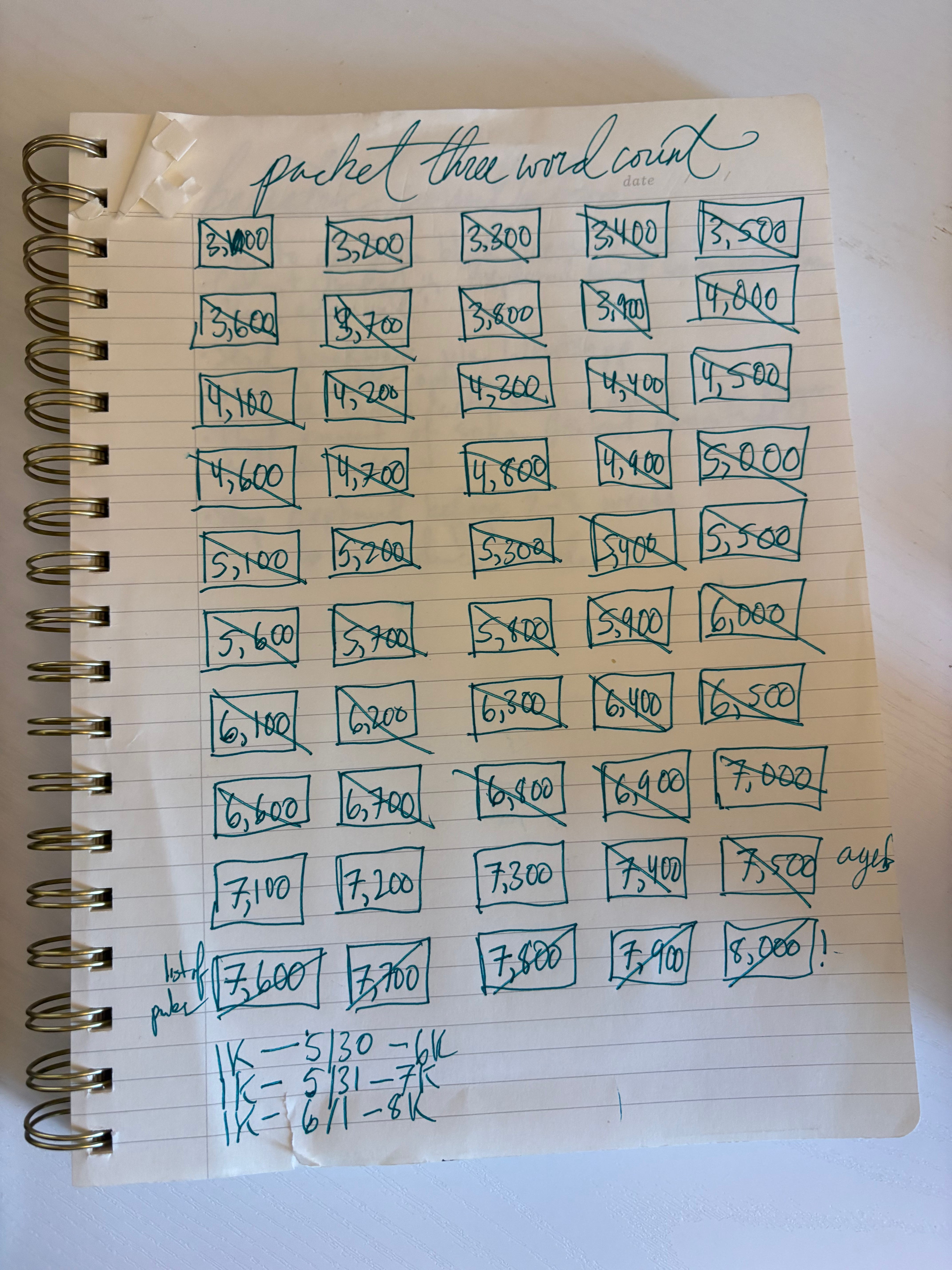
Other ways to emulate the same effect are using Notion’s kanban boards feature, or even a simple paper to-do list. Whatever helps you track your output works.
If you’re into digital tools, I’d like to give a shout-out to Arvin Ahmadi’s Jolt writing tracker. I’ve been slacking on using it (sorry, Arvin) because I’ve been drafting in Scrivener but, due to the atrocious Compile feature, I’m likely switching to Google Docs, which is compatible with Jolt. You can send me your email for a Jolt referral. I’ve also tried Trackbear and good old-fashioned spreadsheets with my friends.

stop bitching about low word count days
Yes, you wanted to write 1,500 words today, but you ended up with 550 instead because you got distracted by your job and your dog and watching Grey’s Anatomy with your long distance best friend and drunk-texting your situationship after the tarot cards told you to.
Life happens. Life will derail your best-laid writing plans. You can either let that minute failure stop you, or you can press on in spite of it and get over yourself.
Also, there is no failure in a life well-lived. If the reason you don’t reach a goal is because you were out there building community and spending time with your family, there’s a whole lot of value—and even inspiration!—in that.

know when to call it.
Going in, I knew that some of these scenes were not going to be up to my quality standards, and I knew that they would contain [BRACKETS TO INDICATE WHERE XYZ SHOULD GO] and highlights and comments as to where to go next. When you’re working with a partner, such as a mentor, agent, or editor, I think that’s okay. Part of the job is to help you ideate when you get stuck on a plot point or decide if a character’s motivation makes sense.
A huge part of writing—and life—is revision, which is…essentially the thesis of this newsletter. Change is the only constant, a phrase that bears constant repetition as we expect perfection from ourselves and from our writing.
My best advice? Build in buffer time to complete your big projects, then, for God’s sake, take a break. You can’t create under pressure all the time. Pressure induces work that’s not up to snuff, and I know your standards are higher than that.2

Thank you for visiting Version CTRL, your destination for honest, slightly acerbic essays for creatives about writing, publishing, mental health, and pop culture. To receive new posts and support my work, consider becoming a free or paid subscriber.
as…not evidenced by the above.
because you follow me, writer extraordinaire, DUH!
Yessss we love to see it! I have a really low minimum daily wordcount (as long as I write one word I count it as a day I have written) and I've managed to average about 1.5k words a day over the last 370ish days so not beating yourself up over low days is a MUST I agree