
experiencing rejection when you have complex PTSD
i'm fighting anger and fear and they're both beating me while yelling "WORLDSTAR"

Since late September, I’ve been entrenched in a depressive episode, made worse by not having one all summer. Life seemed rosy and beautiful and I would never crash again.
I’d forgotten that depression is cyclical, so this instance hit me like a truck. Or a train. Or a bus. Or all three at once.
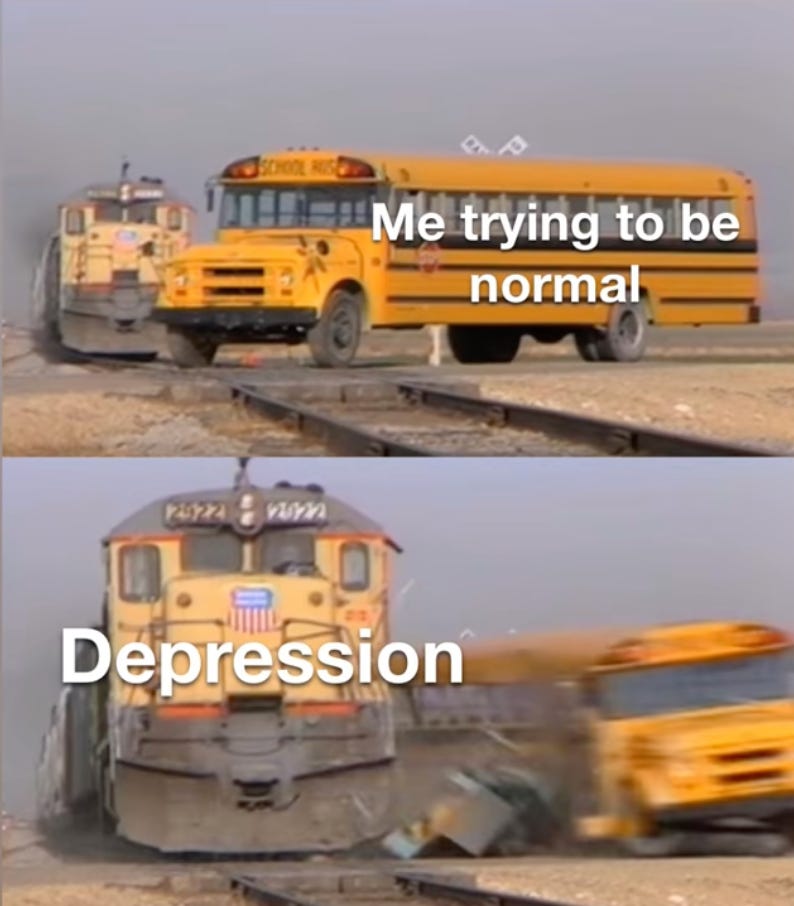
To cope with this utter malarkey and bullshit, I’ve been consuming a lot of mental health-oriented content. I recently watched a YouTube video about self-validation. I’ve been exploring this topic pretty thoroughly, and am drafting a deeper dive into the concept of how the connecting power of the Internet has turned our lives into performance art.
The self-validation part of the video isn’t what struck me. I fell in love with the quote “anger is usually a cover-up for fear.”
Well, friends, that got me good. I’ve been a ball of rage for the past few months, snapping and irritated by trivial matters. I called it “protecting my boundaries and my heart.” Others would say, “baby, you’re traumatized, but you’re also being an asshole.”1
Shortly after I watched the YouTube video, I read tarot for myself. Based on a spread from The Tarot Diagnosis, I drew the following cards.
What I need to hear: Page of Cups upright (full interpretation)
What I don’t want to hear: Queen of Swords reversed (full interpretation)
This was…so clear that I paused after pulling Queen of Swords reversed and said “okay. Alright. I get the point.” The way I interpret this spread is that I’ve lost my signature softness in the name of fiercely protecting myself. Only, there is no reason to protect myself as tightly as I have, because no one in my life is intentionally trying to hurt me.2
My desire for self-protection has been embed within me for over twenty years. For varying reasons, but especially due to bullying in elementary and middle school, I have trouble with both social cues, emotional regulation, and rejection sensitivity. This can be a disastrous combination when I feel slighted, even if the reality of the situation does not reflect my imagination.
Let’s define rejection sensitivity, also categorized as rejection sensitive dysphoria. According to the Cleveland Clinic, “rejection sensitive dysphoria (RSD) is when you experience severe emotional pain because of a failure or feeling rejected…People with RSD are also more likely to interpret vague interactions as rejection and may find it difficult to control their reactions.”3 This sensitivity also extends to the “predisposition to expect and strongly react to being rejected.”4
Rejection, to me, ranges from a lower grade to a stranger not smiling back at me to leaving events after five minutes if no one interacts with me. This leads to me not going for writing, academic, and social opportunities out of fear that I will be turned down, anyway. I’ve been doing a lot better with my sensitivity in recent years, and am learning to not project my own expectations onto other people. I’m also learning to slowly allow myself to be more open to going for what I want.
I recently read a journal article on rejection sensitivity. In several studies, and in Judith Herman’s work, it’s been proven that social support not only can help prevent PTSD/C-PTSD from happening in the first place, but it can lessen symptoms once the trauma has impacted the survivor.5 This is ironic when you consider that trauma survivors tend to self-isolate:
Since trauma can deteriorate a person's wellbeing, survivors may seek to isolate themselves in response to the severity and complexity of their emotions and thoughts following a distressing event (Brand, Schielke, & Brams, 2017). Self-isolation can feel like a protective barrier from past adversities, allowing for some survivors to find comfort in it.
— Downey and Crummy, 2022
I’m definitely someone who self-isolates. This isn’t intentional, but it’s heavily linked to the rejection sensitivity. I’ve talked myself out of this since I hosted a party last month. Out of fifteen-ish people who I invited, two showed up on the day of. Since then, I’ve thought: well, everybody else has more important things to do, and they always will, and I’m not a priority to anyone in my life, and I won’t host anymore or ask anyone to do anything with me!
Let’s…unpack that. These statements are what CBT therapists would call an overgeneralization, as well as discounting a positive experience because it wasn’t “perfect.” There’s also some serious jumping to conclusions here, thinking people are reacting negatively to my general existence. Two people did show up, and a third had an emergency so she couldn’t! Damn! Trauma Brain, please be happy with that! Two people took the time out of their lives to come have fun with me, hang out with my cats, and eat my food.
Hosting a party was actually a huge win, especially in terms of putting myself out there, and I think I’ll do it again. I’ve been joking about hosting a party for my cat’s fifth birthday in June and—fine, okay, I won’t do that.
There’s no real takeaway or bright end of the tunnel in this article. I am still dealing with these issues, and I likely always will in some form. As long as I improve and understand myself, I am fine with this.
Mostly. Experiencing trauma feels like a lifelong sentence for a crime you never committed, a punishment for an unknown aberration. You can break your way out of prison, but the mental jail of C-PTSD changes you. (Seriously, look at the brain scans.)
That’s all for now, friends. Thanks for listening as I ramble more than usual.
wait, don’t you usually talk about writing?
Yes, I do!
C-PTSD impacts my worldview and life experiences and, therefore, affects my writing. My goal with these posts is to offer a first-person perspective of C-PTSD, which is a misunderstood disorder that requires different healing modalities and care than PTSD.
First-hand accounts have helped me along my healing journey, so I hope these posts do the same for someone else.
Other posts about complex PTSD that I’m interested in:
What even is C-PTSD and how does it differ from PTSD?
C-PTSD and grad school
C-PTSD book reviews
Coping skills (once I figure this out)
If you’re interested in any other topics or have questions, feel free to email me or comment. Until next time, stay safe and take care of yourself.
As Ariana and Cynthia taught us, we can hold space for both.
THIS TIME, anyway.
There is a debate about the usage of victim vs. survivor. I find both terms inadequate, but, for the sake of choosing something, I default to survivor.